Your customer likes it. Can they get it approved?
Before spending more to attract buyers, I’d check what happens to the ones already interested.
Someone watches your demo, asks good questions and says, “This looks useful. Let me discuss it with my team.”
Then nothing.
Sales follows up. Marketing sends a case study. Someone suggests a discount.
But we still haven’t established what happened in that internal conversation.
Did their manager question the price? Did IT raise a concern? Did the person who liked the product struggle to explain why the team needed it?
In my opinion, that’s a marketing problem worth investigating before we decide we have a lead problem.
Welcome to There’s a Brief in This. I’m Swati. Each issue takes one marketing problem and works through what I’d do about it, why, and how I’d decide whether it helped.
For this first issue, let’s follow the sale beyond the person who booked the demo.
The conversation we’re missing
Imagine you’re marketing project-management software.
A team lead likes it because their current process involves chasing updates across spreadsheets and messages. Your demo shows them a better way.
Their manager has a different question: “Will this actually change how people work?”
Finance asks what the annual commitment includes.
IT asks about permissions and data access.
All reasonable. All different.
Your contact now has to answer these questions on your behalf. If the only thing they can forward is the demo recording, you’ve given them homework.
This isn’t a rare complication in B2B buying. Gartner reported in 2025 that 74% of buyer teams demonstrated unhealthy conflict during the decision process, including conflicting objectives and disagreement about the decision. That finding doesn’t explain any particular lost deal, but it gives us a reason to examine what happens inside the buying group.
Edelman and LinkedIn’s 2025 research adds another useful detail: 71% of hidden buyers reported relatively little interaction with sales. These are people influencing the decision whom your salesperson may barely speak to.
So I wouldn’t assume that convincing our main contact means we’ve made the case to everyone involved.
First, find out why the decision stopped
Here’s the distinction I’d want the team to make:
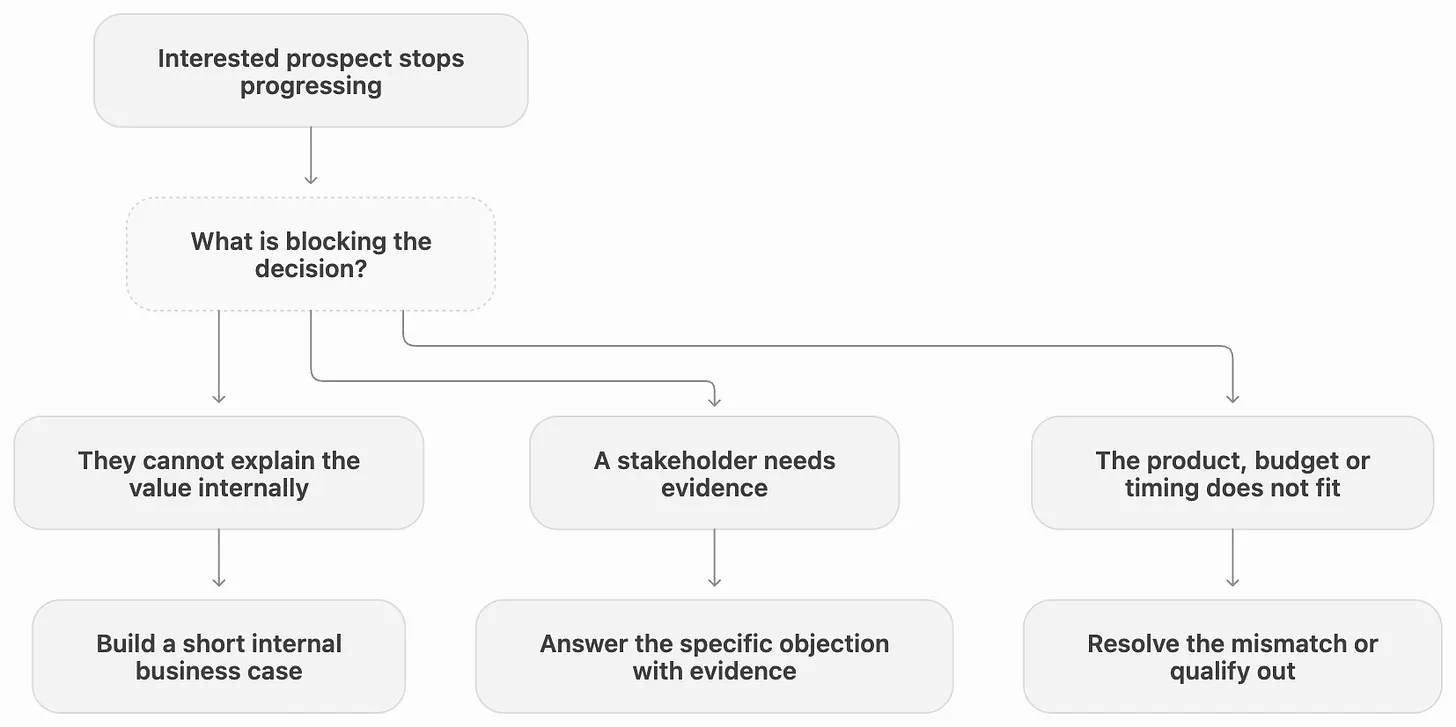
This is my proposed diagnostic, not a finding from the research.
That last branch matters. A better document cannot fix a product that lacks a required feature. It also cannot create a budget that doesn’t exist.
I’d want marketing to recognise those limits rather than turn every stalled deal into a content request.
What I’d do before making anything
I’d review a small set of recent opportunities with sales: some that progressed after internal discussions, some that stalled, and some we lost.
For each, I’d ask:
Who else became involved?
What did they question?
What did our contact forward?
What information was missing?
What ultimately moved—or stopped—the decision?
Where possible, I’d ask customers directly. CRM notes are useful, but “budget issue” can hide several different conversations.
Then I’d look for repeated objections. Those would determine what we make first.
Give each person the answer they need
Using the software example, this is what I’d build if those objections appeared repeatedly:
| Person involved | Their question | Material I’d provide |
|---|---|---|
| Team lead | How do I explain why we need this? | An editable, one-page proposal connecting the product to their team’s problem |
| Manager | Will the benefit justify the disruption? | A rollout plan showing effort, responsibilities and a realistic adoption timeline |
| Finance | What will we actually spend? | Full pricing, contract terms and relevant additional costs |
| IT or security | Does this meet our requirements? | Accessible technical documentation and a clear route for unresolved questions |
I’d keep the proposal short enough to use in a real conversation. The supporting detail can sit behind links.
And I’d include limitations. If migration takes work, say so. If a feature costs extra, make that visible. Our contact shouldn’t discover the awkward detail while defending the recommendation.
Make it part of the sales process
A new folder of documents won’t accomplish much by itself.
I’d introduce the material when the prospect says they need to discuss the purchase internally. Sales could ask:
“Who needs to weigh in, and what will they want to know?”
That answer determines what gets sent. Finance doesn’t automatically need the entire technical pack. IT doesn’t need another brand film.
I’d also assign an owner to each document, with sales, product or technical colleagues responsible for checking the relevant information. Outdated pricing or an inaccurate capability claim would undermine the whole exercise.
How I’d test whether it works
I wouldn’t call this successful because a PDF got downloaded.
The commercial question is whether interested prospects become better able to reach a decision.
| Measure | What it helps us understand |
|---|---|
| Progression after internal review | Are more suitable opportunities reaching the next agreed stage? |
| Time spent awaiting internal approval | Is the decision becoming easier to complete? |
| Repeated clarification requests | Which questions are still unanswered? |
| Win rate and reasons for loss | Are we improving outcomes, or simply moving objections elsewhere? |
| Buyer feedback | Did the material actually help their internal discussion? |
Where volume allows, I’d compare similar opportunities receiving the new approach with those using the existing approach. I’d account for deal size, customer type and discounting before drawing conclusions.
With a small pipeline, I’d treat early results as directional and combine them with buyer interviews.
Here’s how I’d act on the result
| What we observe | What I’d do next |
|---|---|
| Better progression, supported by buyer feedback | Expand the approach and keep checking downstream outcomes |
| Material gets used, but decisions still stall | Investigate the remaining objection before producing more content |
| Buyers consistently raise a genuine product gap | Take the evidence to product and leadership |
| Sales and customers rarely use the material | Check its timing, usefulness and accessibility before adding anything else |
My recommendation
Before commissioning another campaign to fill the pipeline, I’d audit the point where interested buyers go away to seek agreement.
If the evidence shows they’re struggling to explain the purchase, I’d make that easier—and test whether it improves progression.
If the evidence shows the product, price or timing is wrong, I’d address that directly.
Marketing should help people make a sound decision about our product, including the people who never attend our demo.
That’s the work I’d prioritise here. Find the unanswered question. Put a useful answer in the customer’s hands. Measure whether the decision moves.
—Swati
Thanks for reading! Subscribe for free to receive new posts and support my work.
Enjoyed this piece?
Share it with someone who works in B2B marketing, or subscribe for the next issue of There’s a Brief in This.